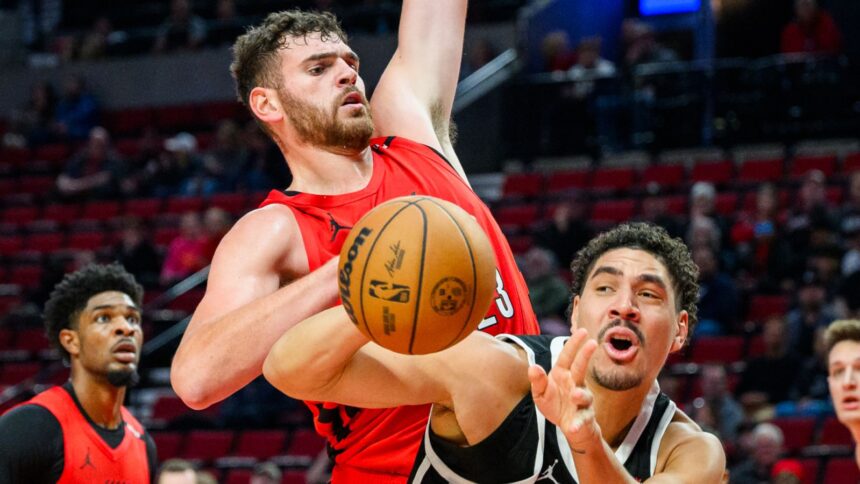
London Lions created a landmark moment for British basketball by becoming the first club from the country to face an NBA team, although the historic occasion ended with a clear demonstration of the gap at the highest level as the Portland Trail Blazers claimed a commanding 119-66 preseason victory in Oregon.
The meeting at Moda Center on October 12 carried far greater significance than the final score alone.
British clubs have crossed paths with NBA organisations in international competitions before, but none had previously played directly against an NBA franchise. London therefore stepped onto the court knowing they were making history before the opening possession.
Portland quickly showed why the challenge was so demanding.
The Trail Blazers led 34-21 after the first quarter before taking complete control during the second period. A devastating 38-12 quarter allowed the hosts to build a 72-33 half time advantage, effectively ending any realistic chance of an upset.
Portland continued to dominate after the break, reaching 100 points before the end of the third quarter and eventually completing a 53 point victory.
At one stage the advantage reached 57 points.
The difference in shooting efficiency was particularly striking.
Portland converted 56 per cent of its attempts from the field and made 16 of 34 shots from three-point range.
London managed only 30 per cent overall and hit seven of their 33 three point attempts.
The Trail Blazers also dominated the interior battle, scoring 54 points in the paint compared with London’s 24 and winning the rebounding contest 51-32.
Turnovers created another major problem for the visitors.
London committed 24 during the game, allowing Portland to score 39 points from those mistakes.
By contrast, the Lions produced only 14 points from Trail Blazers turnovers.
Portland’s ball movement was another reminder of the level London were facing. The NBA side registered 32 assists on 45 made field goals as they consistently moved the defence and created high quality opportunities.
There was briefly a moment in the first quarter when the Lions threatened to stay competitive.
Ethan Price connected on two long range shots in quick succession, reducing Portland’s advantage to just four points at 23-19 with approximately three minutes remaining in the opening period.
That spell provided London with one of their most encouraging stretches of the evening.
But Portland responded strongly and gradually removed any uncertainty from the contest.
A 15-0 run late in the second quarter was particularly damaging and ensured the teams entered half time with the outcome already heavily tilted towards the NBA hosts.
Maxwell Lewis, the only member of the Lions squad with previous NBA experience, finished as London’s leading scorer with 13 points.
He also contributed five rebounds and recorded a game high four steals.
Devante Adams added 12 points from the bench, while Price and Joel Scott scored eight each.
Thomas Kennedy collected six rebounds, including three on the offensive glass.
It was a more difficult evening for Great Britain international Tarik Phillip, who missed all eight of his field goal attempts and finished with three points from free throws.
Portland spread the scoring across a deep roster.
Toumani Camara and Scoot Henderson finished with 14 points each, with Henderson making four of his five three point attempts despite playing only 16 minutes.
Yang Hansen and Sidy Cissoko added 13 points apiece.
Jeremy Sochan, who spent part of his childhood in England, contributed eight points and a game high eight rebounds.
Ja Morant finished with five points and five assists, while Portland’s starters were used relatively lightly and none returned after half time.
The Trail Blazers moved to 2-0 in preseason action with the victory.
For London, the unusual conditions surrounding the game also added to the difficulty.
The match was played under NBA regulations, which meant 12 minute quarters instead of the 10 minute periods used in European basketball.
The court dimensions were different and the NBA three point line was further away.
Those adjustments may appear small individually, but together they created another layer of difficulty against opposition already possessing a major advantage in athleticism, depth and NBA level experience.
The Lions were also completing a demanding trip in the middle of their domestic and European campaigns.
They travelled close to 10,000 miles for the round trip, arriving in Portland on Saturday and leaving immediately after Monday’s game.
The squad even remained on British time during the visit in an effort to reduce the impact of jet lag, which meant players were waking for breakfast at around 4am local time.
Head coach Tautvydas Sabonis admitted the timing was far from perfect, but the fixture carried special meaning for him personally.
His father, legendary Lithuanian centre Arvydas Sabonis, spent seven seasons playing for Portland during the 1990s and early 2000s.
The younger Sabonis had not visited Portland for more than a decade before returning as coach of the British champions.
London arrived in Oregon with strong domestic form behind them.
The Lions won all four major domestic competitions last season and had started the current Super League Basketball campaign with a 5-0 record.
They had also won one of their opening two EuroCup group matches.
In 2024, London became the first British men’s club to reach the EuroCup semi-finals, another important milestone in their effort to raise the profile of British club basketball.
That ambition extends beyond this exhibition game.
London have submitted a bid to join the EuroLeague, which has plans to expand from 20 to 24 teams by the 2027-28 season.
The Lions are also operating at a time when the NBA itself is exploring the possibility of a future European competition, with London among the cities regularly mentioned as a potential market.
Monday’s game was not directly connected to those expansion discussions, but it gave the Lions a rare opportunity to measure themselves against NBA competition and showcase British basketball on a much larger international stage.
The result was undoubtedly harsh.
Portland’s superior shooting, rebounding, depth and defensive pressure made the difference obvious, while the Lions struggled to adjust to the speed of the game and were heavily punished for mistakes.
Yet the trip was never only about attempting to beat an NBA team.
For London, sharing the court with Portland represented another step in a wider attempt to strengthen the reputation and ambition of British basketball.
The scoreboard delivered a tough lesson in Oregon, but the occasion itself ensured the London Lions returned home having achieved something no British club had done before: facing NBA opposition on the same court and taking another historic step onto basketball’s global stage.