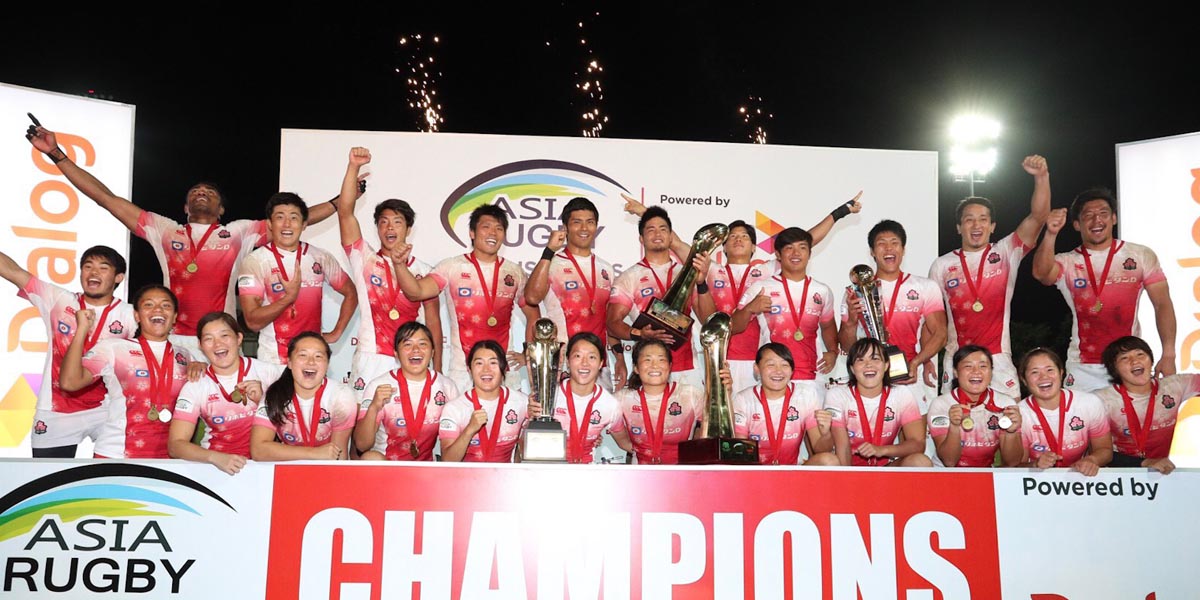
Japan finished the Colombo leg of the 2026 Asia Rugby Emirates Sevens Series in dominant fashion, claiming both the men’s and women’s Cup titles at the Racecourse Grounds, while Sri Lankan rugby also marked an emotional farewell to veteran Srinath “Soori” Sooriyabandara.
The men’s final saw Japan defeat Hong Kong China 28-14, completing an impressive weekend in which they powered through the knockout rounds with authority. Japan had beaten the United Arab Emirates 47-14 in the quarter finals before shutting out China 33-0 in the semi finals to book their place in the title match.
Their victory in Colombo was particularly significant after finishing second at the opening leg of the series in China. Japan arrived in Sri Lanka determined to turn that disappointment into a title and produced the response they were looking for.
They had already set the tone on the opening day by comfortably topping their pool, beating Uzbekistan 40-5, Malaysia 54-5 and Thailand 38-14.
Hong Kong China, however, still had reason to celebrate despite losing the Colombo final.
Both teams finished the men’s series level on 38 points, but Hong Kong China claimed the overall championship on points difference, edging Japan by +363 to +343 across the competition.
Japan’s women were even more impressive.
The Sakura Sevens defeated Singapore 48-0 in the quarter finals and Kazakhstan 42-5 in the last four before overcoming China 14-7 in a hard fought final. That victory gave Japan the Colombo title and the overall women’s series championship.
For Sri Lanka, the men’s competition ended with a fifth place finish and plenty of mixed emotions.
The home side had made an encouraging start during the pool stage, recording victories over the UAE and India and finishing second in their group behind Hong Kong China.
Their hopes of challenging for the Cup ended in the quarter-finals, however, when China edged them 26-19.
Sri Lanka responded positively rather than allowing that defeat to define the rest of their home tournament.
They beat the UAE 26-10 in the fifth place semi final before producing a commanding 33-5 victory over Malaysia in the classification match. The result represented a clear improvement from their seventh place finish at the opening series leg in China.
The victory over Malaysia also carried far greater significance because it marked the final international appearance of Srinath Sooriyabandara, one of the most recognisable names in Sri Lankan sevens rugby.
Sooriyabandara brought the curtain down on a distinguished career that stretched across more than 16 years at the highest level. Other local reports describe his international service as spanning more than 17 years, underlining just how long he remained a central figure in the national setup.
His farewell turned the final classification game into an emotional occasion for the home crowd.
Sooriyabandara has been one of the defining Sri Lankan sevens players of his generation, admired for his pace, footwork, vision and ability to create opportunities in broken play.
Across numerous Asian competitions and international tournaments, he became one of the players most closely associated with Sri Lanka’s sevens identity.
His final appearance therefore represented more than simply the end of one player’s career.
It marked the closing of an era.
Sri Lanka’s fifth place finish also offered some encouragement for the younger players expected to carry the team forward.
After a difficult opening leg in China, the improvement in Colombo showed greater resilience and composure, particularly after the disappointment of the quarter final defeat.
That response will be important as Sri Lanka continue rebuilding their sevens programme and attempt to close the gap on leading Asian nations such as Japan and Hong Kong China.
The Colombo competition once again highlighted the depth at the top of Asian sevens rugby.
Japan’s men were particularly impressive in the knockout stages, scoring 108 points across three matches while conceding only 28.
Their 33-0 semi final win against China demonstrated the defensive intensity they brought into the decisive stages, while the final against Hong Kong China showed they could also handle a more experienced opponent under pressure.
Japan’s success also represented a strong response after a difficult Asian Games campaign.
The team had missed out on gold at Aichi-Nagoya 2026 and finished with bronze, making the Colombo title an important opportunity to re establish momentum.
The women’s title completed a perfect weekend for Japanese rugby.
Winning both Cup competitions underlined the depth of Japan’s sevens programmes and provided another reminder of their position among the strongest nations in the region.
For Sri Lanka, the weekend produced a very different story.
There was disappointment at not reaching the men’s semi finals, encouragement from the recovery to fifth place, and emotion surrounding the departure of one of the country’s longest serving sevens stars.
The Racecourse Grounds therefore witnessed both a celebration of Japan’s present strength and a farewell to an important part of Sri Lankan rugby history.
Japan left Colombo with both Cup trophies, while Hong Kong China still secured the overall men’s series crown. But for the home crowd, the lasting image of the weekend may be Srinath Sooriyabandara walking away from international sevens for the final time after giving more than a decade and a half to Sri Lankan rugby.