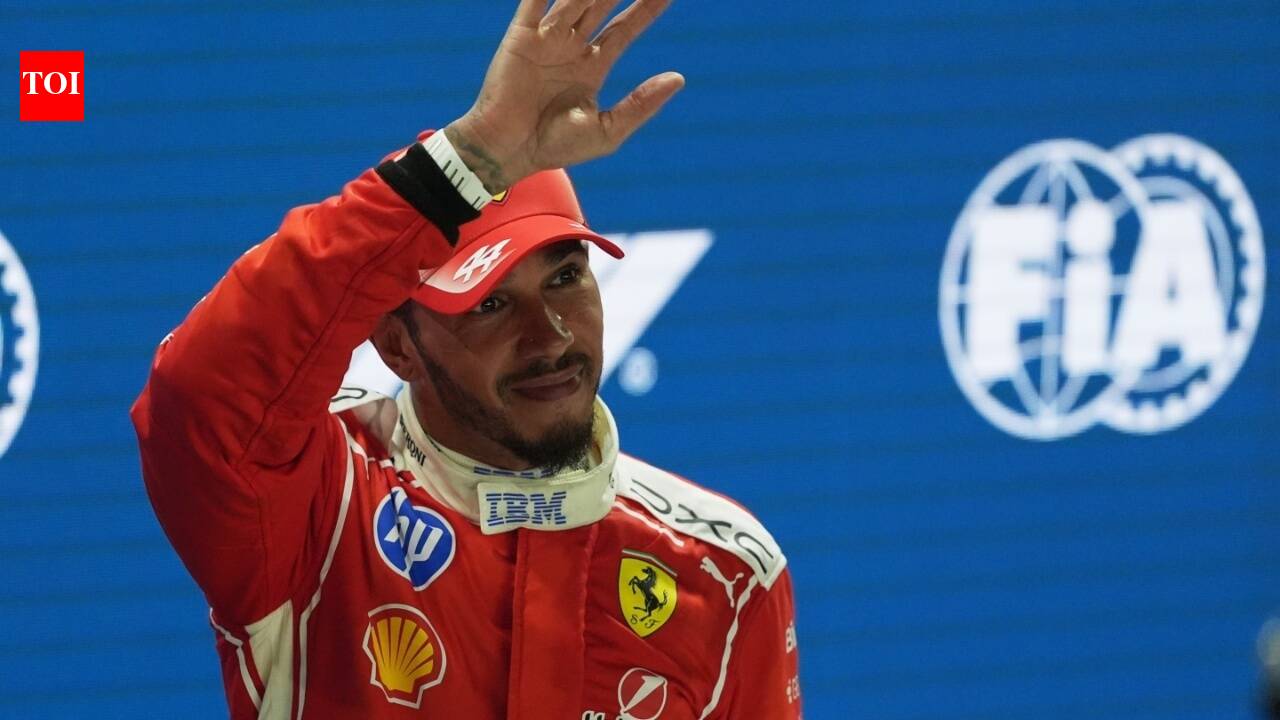
Lewis Hamilton has taken full responsibility for the strategy decision that cost him a potential podium at the Singapore Grand Prix, describing the disappointing outcome as a “painful lesson” in a message posted to Instagram following Ferrari’s missed opportunity at Marina Bay.
Hamilton entered Sunday’s race with genuine hopes of securing a strong result after qualifying third behind Max Verstappen and Ferrari team mate Charles Leclerc.
The seven time world champion remained in podium contention during the opening stages and Ferrari appeared capable of placing both cars inside the top three.
However, one crucial decision during a Virtual Safety Car period transformed Hamilton’s race.
When Lance Stroll’s retirement triggered the VSC, Ferrari called both of its drivers into the pits for fresh tyres. Leclerc followed the instruction, but Hamilton missed the pit entry and then chose to remain on track rather than attempting another stop.
The decision left Hamilton trying to protect track position on increasingly worn tyres.
Initially, the gamble appeared to offer a possibility of maintaining third place, but tyre degradation became increasingly severe during the final part of the race.
Leclerc, benefiting from fresher rubber, moved ahead and eventually secured second place behind race winner Verstappen.
Hamilton was then unable to resist Mercedes driver Kimi Antonelli and McLaren pair Lando Norris and Oscar Piastri as his grip disappeared.
Instead of celebrating a Ferrari double podium, Hamilton eventually crossed the line in sixth position.
The result clearly frustrated Hamilton, who immediately accepted responsibility over team radio.
He apologised to Ferrari and acknowledged that his own strategy call had cost the team valuable championship points.
The British driver later expanded on those comments in an Instagram statement, making clear there had been no attempt to shift responsibility towards Ferrari’s strategists.
Hamilton said the result was not what the team wanted and admitted that the decision had been his.
He explained that overtaking is extremely difficult around Marina Bay, which encouraged him to attempt something different rather than simply following the conventional strategy.
The gamble failed, but Hamilton insisted that mistakes are part of racing and that the important issue is how a driver responds afterwards.
He described Singapore as a “painful lesson” while stressing that he accepted full responsibility.
Hamilton also thanked Ferrari for the work carried out throughout the weekend and argued that sixth place did not accurately represent the speed available in the car.
He promised to continue working and return stronger when Formula 1 heads to the United States Grand Prix in Austin later this month.
Ferrari team principal Frederic Vasseur supported Hamilton’s account of what happened.
Vasseur confirmed that the team had intended to pit both cars during the VSC and that Hamilton had been called into the pits.
There was no communication failure from the pit wall.
After missing the entrance, Hamilton ultimately decided to remain out and attempt to make the existing tyres last until the finish.
Vasseur admitted the outcome showed it had been the wrong decision but also defended the principle of listening to drivers because they are the ones experiencing tyre behaviour from inside the car.
The frustration was increased by Ferrari’s pace throughout the weekend.
Leclerc pressured Verstappen early in the Grand Prix and briefly threatened the Red Bull at the front before ultimately finishing a little over seven seconds behind.
Hamilton had also shown enough speed to suggest Ferrari could have achieved a double podium had the strategy unfolded differently.
Verstappen eventually claimed his first Singapore Grand Prix victory, with Leclerc second and Antonelli completing the podium.
Norris finished fourth ahead of Piastri, leaving Hamilton sixth after his late loss of positions.
The physical demands of the race added another difficult element to Hamilton’s evening.
Ferrari confirmed that he felt unwell after completing the Grand Prix and was assessed by the FIA medical team.
He was subsequently given permission to miss his normal post-race media commitments.
Singapore has always been regarded as one of Formula 1’s toughest events because of the combination of extreme humidity, high temperatures and the physical demands of racing between barriers for more than two hours.
Running an extended stint on degrading tyres only added to Hamilton’s workload.
Despite the disappointment, there were positives for Ferrari.
The SF-26 demonstrated enough pace to fight near the front, while Leclerc’s second place confirmed the team remained competitive against Red Bull, Mercedes and McLaren.
Vasseur pointed out that Formula 1’s leading four teams are separated by extremely small performance margins, meaning relatively minor upgrades or strategy differences can completely change the finishing order from one weekend to the next.
Hamilton’s immediate challenge will be ensuring Singapore becomes an isolated error rather than the beginning of another difficult run.
His willingness to publicly accept responsibility will likely help Ferrari move on quickly from the incident.
Formula 1 strategy regularly requires drivers and teams to make decisions within seconds, particularly during Virtual Safety Car periods when the advantage of stopping can disappear almost immediately.
On this occasion, Hamilton’s instinct to preserve track position worked against him.
He had hoped to turn an alternative approach into a podium.
Instead, the ageing tyres left him vulnerable precisely when the race entered its decisive stages.
The setback is also important in the wider championship picture.
With six rounds remaining, Mercedes youngster Antonelli has strengthened his position at the top of the standings, while Hamilton’s sixth-place result prevented him from taking full advantage of Ferrari’s strong Singapore performance.
But Hamilton’s message after the race was centred less on the championship mathematics and more on accountability.
Rather than blaming strategy software, tyre behaviour or pit-wall communication, he accepted that the decisive call had been his and acknowledged that Ferrari deserved more from the weekend.
That response may prove important as the team turns its attention towards Austin.
Singapore offered Hamilton and Ferrari the possibility of celebrating two cars on the podium, but one missed pit opportunity changed the entire race. The seven-time champion has accepted the consequences, labelled the experience a painful lesson and promised that his response will come on track at the next Grand Prix.