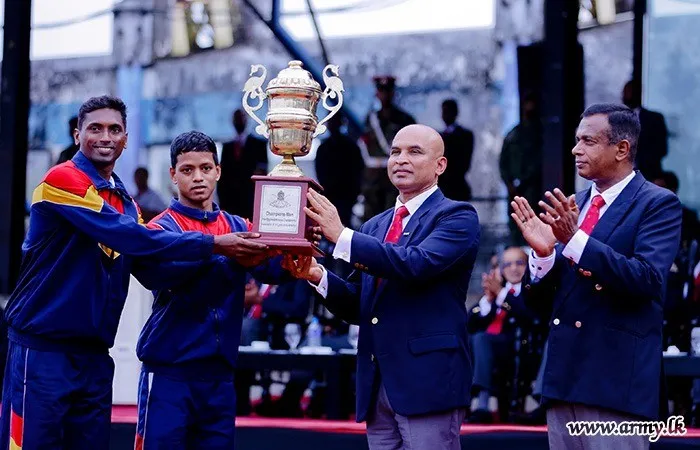
The 61st Sri Lanka Army Athletics Championships concluded at the Mahinda Rajapaksa Stadium in Diyagama after three days of competition, with seven new meet records highlighting another strong edition of one of the country’s most important military athletics events.
The championships were held from October 27 to 29, bringing together athletes from across the Sri Lanka Army’s regiments to compete in track, field and combined events. The meeting is also listed on the World Athletics competition calendar, underlining its place within Sri Lanka’s organised athletics programme.
The closing ceremony was attended by Commander of the Army Lieutenant General Nilantha Premaratne, who served as chief guest as the final events and awards brought the 61st edition to an end.
He was welcomed by Major General B.G.S. Fernando, Chief of Staff of the Army and Chairman of the Army Athletics Committee, before the final programme of events got under way.
The last day featured several of the championship’s most anticipated races, including the men’s and women’s 100 metres, men’s 1500 metres and the men’s and women’s 4×400 metre relays.
Those events provided an energetic finish to a competition in which athletes repeatedly challenged existing championship standards.
By the conclusion of the meet, seven new records had been established.
Among the leading performances in the men’s competition was a new meet record of 51.43 seconds in the 400 metres hurdles, demonstrating the high standard produced in one of athletics’ most technically demanding events.
Another major record came in the men’s decathlon, where the championship mark was raised to 7,045 points.
The decathlon is one of the toughest disciplines in athletics because competitors must perform across 10 different track and field events, requiring a rare combination of speed, strength, endurance and technical ability.
Breaking the Army Championships record therefore represented one of the standout achievements of the three day meeting.
The women’s events also produced several record breaking performances.
New championship marks were established across relay competition, the 10,000 metres and the heptathlon.
The women’s 10,000m record was improved to 34 minutes 50.98 seconds, while the new heptathlon benchmark was set at 4,429 points.
The strong performances across both individual and team events reflected the depth available within Army athletics.
For decades, the Sri Lanka Army has played an important role in providing athletes with the facilities, coaching structure and competitive opportunities required to continue developing their careers.
Many leading national athletes have represented the Armed Forces, making events such as the Army Athletics Championships an important part of the domestic sporting calendar.
Competition between regiments is also a major feature of the championships.
Athletes are not only chasing medals and individual records but also earning points towards the overall team standings.
That creates an additional layer of competition, with every placing capable of influencing which regiment ultimately takes home the major trophies.
In the women’s championship, the Sri Lanka Army Women’s Corps emerged as the leading regiment after collecting 255 points.
Their consistency across the programme allowed them to secure the Inter Regiment Challenge Trophy for the champion women’s regiment.
The Sri Lanka Army Service Corps finished close behind with 245 points, earning the award for the most outstanding runner up regiment in the women’s competition.
Only 10 points separated the two teams, highlighting how competitive the battle for the women’s overall title remained throughout the championships.
The men’s championship produced another closely contested team battle.
The Sri Lanka Electrical and Mechanical Engineers finished on top with 222 points, securing the Overall Champions Challenge Trophy.
The Sri Lanka Army Service Corps once again finished second, recording 205 points and completing an impressive championship in which the regiment secured runner up honours in both the men’s and women’s categories.
That consistency made the Army Service Corps one of the strongest overall performers of the competition even though it narrowly missed out on both championship trophies.
For the Electrical and Mechanical Engineers and the Army Women’s Corps, however, the final standings represented the reward for three days of performances across a wide variety of disciplines.
The Army Championships are particularly valuable because they provide athletes with opportunities beyond the country’s major national meets.
Regular high level competition is essential for developing race awareness, technical consistency and the ability to perform under pressure.
For younger Army athletes, competing alongside more established performers can also provide an important stepping stone towards national selection.
The presence of combined events such as the decathlon and heptathlon further strengthens the programme.
These disciplines require extensive training across multiple events and are often more difficult to stage than individual track races or field competitions.
The record performances in both competitions suggest encouraging progress among the Army’s multi event athletes.
The championship also showcased the value of relay competition.
Relay events demand more than individual speed, requiring precise baton exchanges, tactical awareness and strong teamwork.
They are therefore particularly appropriate within a military sporting environment where collective performance and discipline are strongly emphasised.
The Mahinda Rajapaksa Stadium in Diyagama once again provided the setting for the competition.
The venue remains one of Sri Lanka’s key athletics facilities and regularly hosts major domestic championships, providing athletes with access to a recognised track and field environment.
World Athletics listed the 61st Army Athletics Championships as taking place at Diyagama from October 27 to 29 and covering track and field, combined events and race walking.
The closing ceremony brought together senior officers, athletes and spectators as medals and championship trophies were presented to the leading performers.
Lieutenant General Premaratne and other senior Army officials took part in the awards ceremony, recognising both individual excellence and the achievements of the winning regiments.
The seven new meet records provided perhaps the clearest indication of the sporting quality on display.
Records give athletes a measurable target from one championship to the next, and each new benchmark raises expectations for future editions.
For the athletes responsible, those performances also offer evidence that their training is translating into competitive progress.
The championship therefore served two purposes.
It celebrated the strongest performers currently competing within Army athletics while also identifying athletes capable of contributing to Sri Lanka’s national programme in future domestic and international competitions.
With national sporting bodies increasingly focused on improving high performance pathways, competitions of this nature remain important for discovering and developing talent.
The Sri Lanka Army’s long standing contribution to athletics means that strong performances at its internal championships can ultimately have an impact far beyond inter regiment competition.
The next challenge for the leading athletes will be carrying their form into national events and attempting to improve further against the strongest competitors from other clubs and institutions.
With seven championship records, closely fought team standings and strong performances across track, field and combined events, the 61st Army Athletics Championships delivered another encouraging showcase of Sri Lankan military athletics. The Army Women’s Corps and Sri Lanka Electrical and Mechanical Engineers took the major team honours, while the record breakers at Diyagama provided a glimpse of the talent capable of making an impact on the national stage.