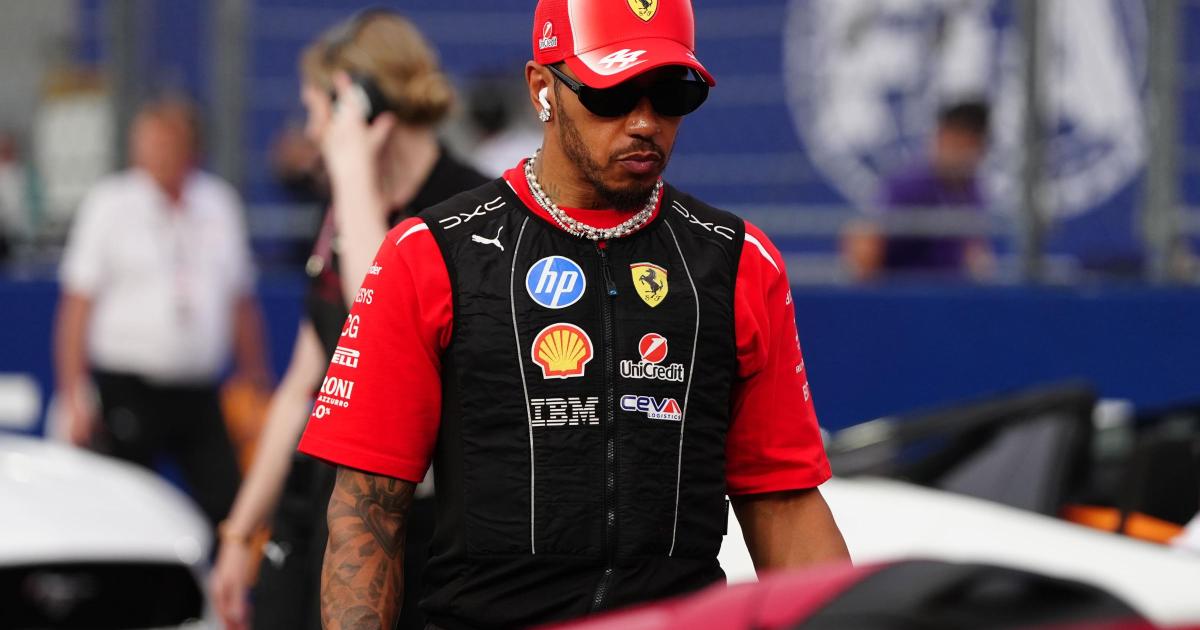
Lewis Hamilton has explained why he took Ferrari’s strategy into his own hands during the Singapore Grand Prix, admitting the decision ultimately cost him a podium while insisting the setback will not stop him from continuing to challenge conventional thinking as Formula 1 heads to Austin.
The seven-time world champion spoke in detail about the incident for the first time ahead of the United States Grand Prix, having previously been unable to complete his normal post race media duties in Singapore after feeling unwell following the physically demanding race.
Hamilton had started third at Marina Bay and deliberately chose a different tyre strategy from Ferrari team-mate Charles Leclerc, who lined up one place ahead of him.
While Leclerc started on the soft compound, Hamilton opted for mediums in an attempt to create a different tactical opportunity rather than simply following his team-mate throughout the race.
Hamilton explained that his thinking was centred around trying to win rather than simply accepting a likely second or third place finish.
With Max Verstappen starting from pole and expected to have strong pace, Hamilton believed running the same strategy as Leclerc could limit Ferrari’s ability to challenge the Red Bull driver.
The gamble did not develop as Hamilton had hoped.
The medium tyre proved less competitive than expected during the opening stint, forcing him to make an earlier stop and switch to the soft compound.
Hamilton then found himself behind Leclerc and began losing valuable time while trying to manage the race.
The decisive moment came later when a Virtual Safety Car presented Ferrari with the opportunity to make another stop.
Leclerc came into the pits for fresh tyres and Ferrari also instructed Hamilton to do the same.
Hamilton, however, was approaching the pit entry when he made the split second decision to remain on track.
He later admitted that almost immediately after passing the entry, he realised it was probably the wrong call.
The decision temporarily promoted Hamilton up the order, but it left him trying to complete the final stages of the race on heavily worn tyres.
Leclerc quickly used his fresher rubber to catch and pass his team-mate before securing second place behind Verstappen.
Hamilton then became increasingly vulnerable as his tyre performance deteriorated.
Mercedes driver Kimi Antonelli and McLaren pair Lando Norris and Oscar Piastri all moved ahead, dropping Hamilton from a potential podium position to sixth by the chequered flag.
Hamilton immediately accepted responsibility over team radio and later repeated that message in a public statement.
He described the Singapore result as a “painful lesson” and apologised to Ferrari for losing valuable championship points.
Team principal Fred Vasseur also made clear that Hamilton’s decision had been the key factor in losing the podium, confirming that Ferrari had instructed him to stop under the Virtual Safety Car.
Speaking in Austin ahead of this weekend’s United States Grand Prix, Hamilton said the experience had been difficult but stressed that mistakes are part of racing.
He explained that he rarely finds himself making such a costly strategic call and admitted the days immediately following Singapore had been frustrating.
However, he also argued that the incident would not make him more conservative.
Hamilton said he still believes part of his role is to challenge both himself and Ferrari rather than automatically following the same strategy every time.
That approach, he suggested, has played an important role throughout his career.
The 41-year-old made clear that he does not intend to simply follow standard procedures if he believes there is an opportunity to gain an advantage.
Hamilton said Ferrari had held productive conversations after Singapore about how communication and collaboration could improve.
He insisted there had been no breakdown in the relationship between himself and the pit wall despite the controversy surrounding the race.
Instead, Hamilton described the episode as a shared learning experience for both driver and team.
That distinction is important because the Singapore incident followed several weekends in which Ferrari’s strategy decisions had come under increasing scrutiny.
Questions were raised about whether Hamilton’s willingness to override the team reflected a lack of confidence in the pit wall.
Former Formula 1 strategist Bernie Collins suggested the situation naturally raised questions about trust, especially because the Virtual Safety Car offered Ferrari what appeared to be an ideal opportunity to fit Hamilton with fresh tyres.
Hamilton’s comments in Austin, however, were clearly intended to dismiss the idea that his relationship with Ferrari had deteriorated.
He stressed that both sides continue to work well together behind the scenes and that challenging decisions should not automatically be interpreted as conflict.
For Hamilton, the larger issue is finding ways to extract more from Ferrari at a point in the season where the performance gaps between the leading teams remain extremely small.
Singapore demonstrated that Ferrari had enough speed to fight near the front.
Leclerc finished second, while Hamilton had shown podium level pace before his strategy gamble went wrong.
That leaves Ferrari with encouragement heading into the United States Grand Prix.
The Circuit of the Americas presents a very different challenge from Marina Bay.
Its combination of fast direction changes, heavy braking zones, long straights and slower technical corners will provide a broader test of Ferrari’s overall competitiveness.
Hamilton also has an impressive history in Austin, having enjoyed considerable success at the circuit throughout his career.
The weekend therefore provides an immediate opportunity to respond to the disappointment of Singapore.
Rather than dwelling on the error, Hamilton has promised to increase his efforts and ensure a similar mistake does not happen again.
He has also made clear that accepting responsibility does not mean abandoning his aggressive approach to strategy.
That could remain important as Ferrari continues battling Mercedes, Red Bull and McLaren during the closing stages of the season.
Hamilton’s desire to pursue alternative strategies has always been connected to his determination to win rather than settle for safe results.
In Singapore, that instinct worked against him.
The medium tyre start failed to provide the advantage he hoped for, while staying out under the Virtual Safety Car transformed a likely podium into sixth place.
But Hamilton believes Formula 1 rewards drivers and teams who are prepared to search for different solutions rather than always accepting the obvious option.
The challenge is finding the balance between innovation and unnecessary risk.
Ferrari will hope Austin provides a cleaner opportunity to demonstrate that balance.
After Singapore, Hamilton knows another strategy mistake would attract even greater scrutiny.
But he also knows that simply following the same approach as everyone around him may not be enough to produce the victories he continues to chase.
Hamilton has accepted that Singapore was his mistake, but the experience has not changed the philosophy behind the decision. As Ferrari arrives in Austin, he remains determined to challenge the team, challenge himself and keep searching for the unconventional calls that could eventually turn strong weekends into victories.