Lando Norris has played down McLaren’s chances of fighting for pole position at the Azerbaijan Grand Prix after a difficult opening day in Baku, while George Russell expects the sizeable practice gaps to shrink significantly when qualifying begins.
Mercedes emerged as the clear early benchmark at the Baku City Circuit on Thursday, with Russell topping both practice sessions and championship leader Kimi Antonelli completing a one two for the team in FP2 despite losing significant track time.
McLaren, meanwhile, endured a more complicated day.
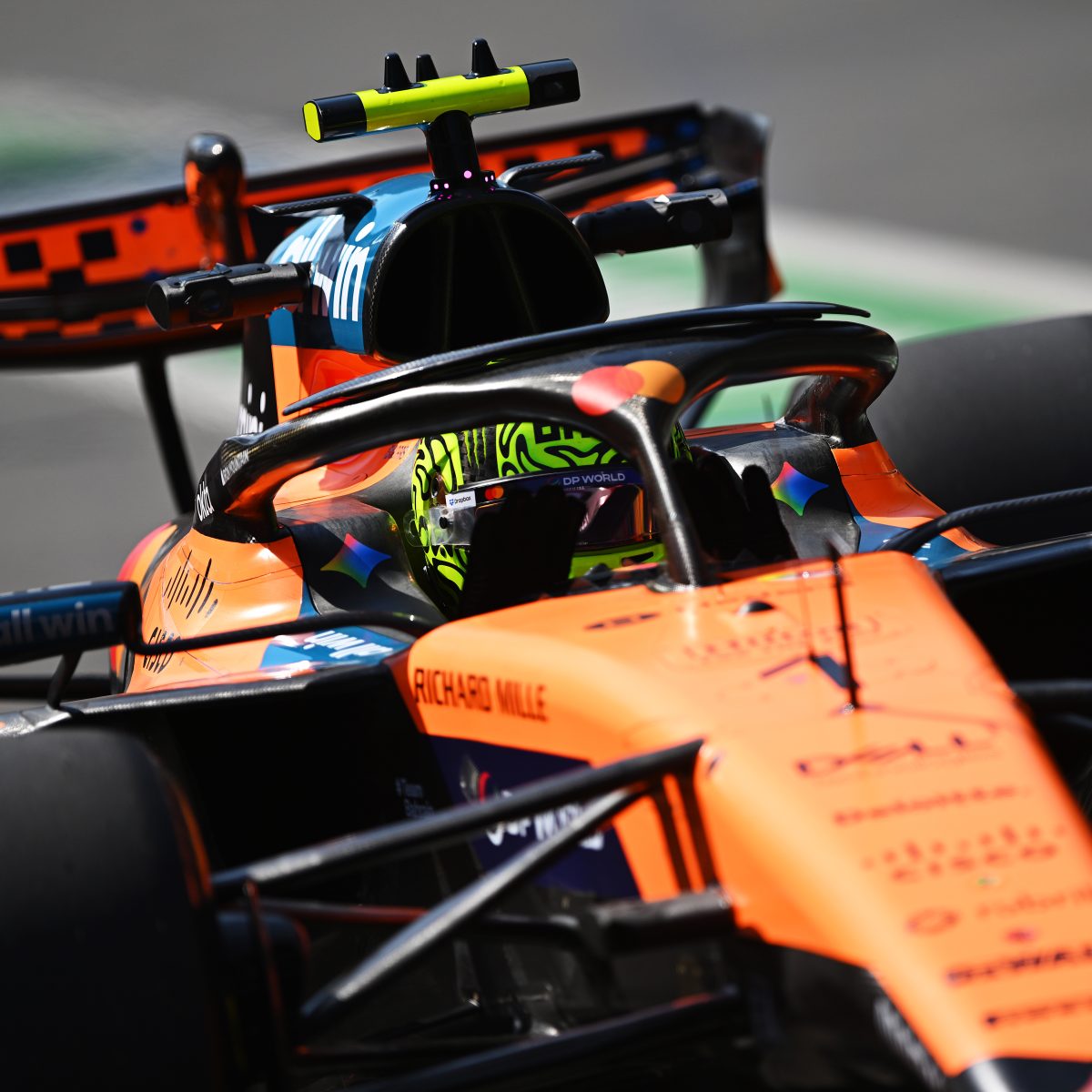
Norris finished sixth in second practice, while Oscar Piastri ended the session eighth. Both drivers were around 1.5 seconds behind Russell’s benchmark time of 1:43.347, leaving Norris particularly pessimistic about McLaren’s prospects of challenging Mercedes over one lap.
Norris described McLaren as being “miles off” the leading pace after practice.
Although he felt the MCL40 was relatively comfortable to drive, the defending world champion said the car simply lacked enough outright speed around Baku’s combination of slow corners and enormous straights.
The Briton admitted that seeing the size of the gap to Mercedes was particularly disappointing because the car itself did not feel as difficult as the timing screens suggested.
McLaren arrived in Azerbaijan with one of its most significant upgrade packages of the season.
The MCL40 features several new aerodynamic components, including revised sidepods, an updated engine cover, changes to the diffuser and a modified floor edge.
However, Thursday’s opening session was disrupted by bodywork and floorboard issues, costing both Norris and Piastri valuable track time while the team attempted temporary fixes.
McLaren chief technical officer Rob Marshall said the initial data suggested the upgrades were behaving in line with the team’s simulations, but admitted the package had not yet been fully optimised for Baku.
That leaves McLaren with considerable work to do ahead of qualifying.
Norris’ fastest lap in FP2 placed him nearly a second and a half behind Russell, although the McLaren driver abandoned another attempt that appeared capable of significantly reducing the deficit.
Even so, Norris believes Mercedes currently hold too large an advantage for McLaren to realistically expect pole position without a major overnight improvement.
Piastri offered a slightly more optimistic assessment.
The Australian said McLaren’s long run pace appeared encouraging and believes there is more performance available once the team understands its new package and improves the setup.
McLaren will use final practice to continue experimenting before qualifying begins later on Friday.
At the opposite end of the mood spectrum, Russell enjoyed an excellent opening day.
The Mercedes driver topped FP1 with a 1:45.387 before improving dramatically to 1:43.347 in FP2.
However, Russell warned against reading too much into the apparent size of Mercedes’ advantage.
He believes several rivals failed to maximise their fastest laps and expects the gaps between Mercedes, Red Bull, Ferrari and McLaren to become considerably smaller once qualifying begins.
Mercedes trackside engineering director Andrew Shovlin expressed a similar view.
Although the team was encouraged by the W17’s performance on both short and long runs, Shovlin said Thursday’s timing screens were unlikely to provide a completely accurate representation of the competitive order.
Several drivers lost time through mistakes, interrupted laps or technical problems, meaning the qualifying battle could be far closer than the practice results suggest.
Antonelli’s day was a perfect example.
The championship leader suffered a hydraulic problem during FP1 and was forced to stop early.
Mercedes then elected to change his power unit as a precaution, costing the Italian further running at the beginning of FP2.
Despite those setbacks, Antonelli recovered impressively to finish second, only 0.552 seconds behind Russell.
He said the car felt comfortable despite his limited track time and was satisfied with the way Mercedes recovered from the early technical problem.
Red Bull also showed signs of being a potential qualifying threat.
Max Verstappen finished third in FP2, 0.827 seconds behind Russell, having also taken second place during the opening session.
The Dutchman said Red Bull’s latest upgrades appeared to be working as intended and believes the team is currently in contention for at least a podium.
Technical director Pierre Wache nevertheless suggested Mercedes appeared to have the strongest short-run pace after Thursday’s running.
Isack Hadjar also returned to action for Red Bull after missing three races with a wrist injury.
The Frenchman’s comeback was disrupted by a gearbox related issue during FP1, but he recovered to complete more representative running in the second session.
Hadjar finished ninth and reported no significant problems with his wrist, describing the updated Red Bull as stronger than the car he last drove before his absence.
Ferrari remain another potential factor in the battle for the front rows.
Charles Leclerc finished fourth in FP2, with Lewis Hamilton fifth, giving Ferrari a relatively clean opening day compared with several of their rivals.
Leclerc acknowledged that the SF 26 lacked some pace compared with Mercedes, while Hamilton identified tyre preparation and straight line speed as two areas requiring improvement.
Ferrari’s form around Baku is particularly interesting because Leclerc has historically been extremely strong in qualifying at the circuit.
That means even if Mercedes retain the advantage seen in practice, Ferrari cannot be discounted once fuel levels drop and drivers begin pushing to the absolute limit.
Baku itself makes predicting qualifying particularly difficult.
The circuit combines slow 90 degree corners with the extremely narrow castle section and one of the longest flat-out stretches on the Formula 1 calendar.
A small mistake can easily ruin a qualifying lap, while slipstreams on the main straight can dramatically influence lap times.
Track evolution is another major factor, meaning the fastest times often come during the final moments of each qualifying segment.
For Norris and McLaren, the objective is now to ensure the current 1.5 second deficit proves misleading.
The team has demonstrated several times this season that it can make significant progress between practice and qualifying, and Marshall believes there is still performance available once the latest upgrade package has been properly tuned.
But Norris is refusing to create unrealistic expectations.
After a practice day in which Mercedes controlled the timing screens, he believes McLaren’s immediate challenge is simply to close the gap rather than think about pole position.
Russell sees the situation differently.
The Mercedes driver may have been comfortably fastest on Thursday, but he expects the picture to change once every team turns up its power unit, reduces fuel loads and pushes harder in qualifying.
That sets up an intriguing battle in Baku.
Mercedes currently appear to have the advantage, Red Bull and Ferrari remain within striking distance, and McLaren are searching for answers after a surprisingly difficult first day.
The Azerbaijan Grand Prix qualifying session takes place on Friday, September 25, ahead of the race on Saturday, September 26.
If Russell’s prediction proves correct, Thursday’s large margins could disappear very quickly leaving Mercedes, Ferrari, Red Bull and potentially McLaren fighting over one of the most important pole positions of the season.