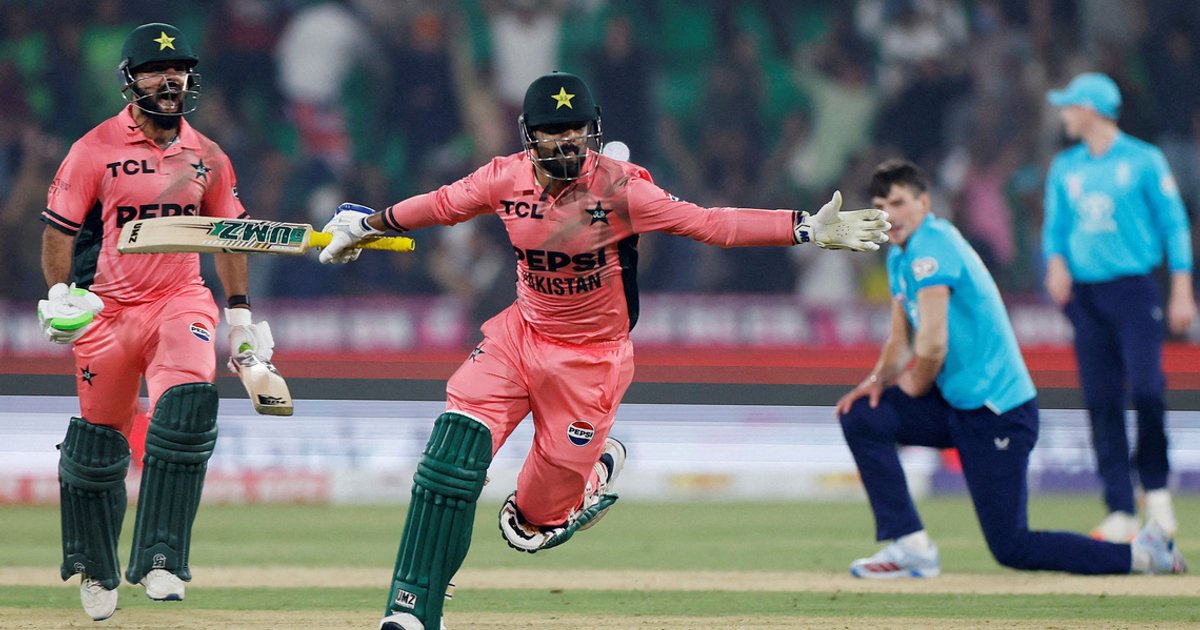
Shadab Khan produced one of the most extraordinary innings of his international career as Pakistan recovered from 154-9 to defeat England by one wicket in Lahore, with his maiden ODI century and a record-breaking last wicket partnership with Haris Rauf sealing a place in the tri series final.
Chasing 242 for victory at the Gaddafi Stadium, Pakistan appeared certain to lose when England’s bowlers tore through the middle and lower order, leaving the hosts nine wickets down with 88 runs still required.
What followed was a remarkable rescue act.
Shadab remained calm while wickets disappeared around him and eventually finished unbeaten on 113 from 96 balls, striking 13 fours and five sixes. At the other end, Rauf contributed only seven not out from 19 deliveries, but his resistance was just as important as the pair put together an unbroken 89 run partnership for the final wicket.
Their stand was the highest last wicket partnership ever recorded in a successful ODI run chase, turning a seemingly inevitable England victory into one of Pakistan’s most dramatic wins in recent memory.
Rauf eventually struck the winning boundary as Pakistan reached the target with 17 balls remaining, completing an extraordinary one wicket victory and confirming their place in the tri series final.
The finish was made even more dramatic by a major scare when Shadab was given out lbw to Gus Atkinson on 97.
Pakistan reviewed the decision and replays overturned the dismissal, keeping Shadab at the crease when his side still needed 21 runs.
He then went on to complete his first ODI century before guiding Pakistan home alongside Rauf.
Earlier, England had also needed a major recovery.
Shaheen Shah Afridi ripped through their top order and finished with 4-46, helping reduce the visitors to 52-4 after a disastrous start.
Ben Duckett then produced the standout innings for England.
The left hander scored 105 from 111 balls, registering his third ODI century and rebuilding the innings after the early collapse.
Duckett found important support from Sam Curran, who made 42, with the pair adding 93 for the fifth wicket.
Their partnership steadied England and gave them a platform from which they could push towards a competitive total.
Gus Atkinson also played an important late role with an unbeaten 36 as England eventually reached 241 all out in 46.4 overs.
Given the way Pakistan’s chase later collapsed, that total appeared for long periods to be more than enough.
England’s bowlers made an excellent start in defence of the target.
Jamie Overton led the attack with 3-43, while Liam Dawson took 2-19 and consistently applied pressure through the middle overs.
Pakistan were already in difficulty at 74-3 before the situation became far worse.
Saad Baig contributed 32 and Salman Ali Agha made 26, but neither could build the substantial partnership Pakistan desperately needed.
As wickets continued to fall, the hosts collapsed to 154-9 in the 34th over.
At that stage, England looked completely in control.
They required only one more wicket, Pakistan still needed 88 runs and Rauf, a specialist fast bowler, had walked in at No. 11.
Shadab, however, refused to surrender.
Rather than protecting Rauf and simply trying to survive, he continued to attack whenever the opportunity appeared.
One of the defining moments came when he swept Atkinson for six as the required total began to fall into a manageable range.
England gradually became more defensive.
With every boundary, Pakistan’s belief increased and the pressure shifted back onto the bowlers.
Rauf played his role perfectly by occupying the crease, allowing Shadab to control most of the scoring.
The partnership showed exactly why lower order resistance can be so valuable in ODI cricket.
Rauf did not need to match Shadab’s scoring rate. He simply needed to survive long enough for the all rounder to keep attacking.
That combination proved enough to completely turn the contest around.
For Shadab, the innings represented a major personal milestone.
He had previously produced several useful ODI performances with the bat, but this was his first century in the format and by far his highest score.
To reach that landmark while batting with the last man and carrying Pakistan through such an unlikely chase made the achievement even more memorable.
The defeat was another painful one for England.
Only three days earlier, they had posted 429 against Sri Lanka before watching the opposition successfully chase 430 in one of the greatest ODI run chases ever recorded.
They have now suffered consecutive defeats after appearing to be in almost unbeatable positions.
England have lost all three of their matches in the tri series so far.
They began with an 87 run defeat to Pakistan in Rawalpindi, then lost the record-breaking thriller against Sri Lanka before being denied by Shadab and Rauf in Lahore.
That leaves Harry Brook’s side on the brink of elimination.
England must now beat Sri Lanka in their final group match and hope other results work in their favour if they are to have any chance of reaching the October 31 final.
Pakistan, in contrast, have secured their place in the decider.
Their victory was built on Shaheen’s early bowling, England’s inability to turn 241 into a winning score and, above all, one of the most remarkable rescue partnerships ODI cricket has seen.
Duckett’s century should have been the defining innings of the match.
Instead, it became another outstanding individual performance overshadowed by an extraordinary defeat.
From 154-9 and seemingly finished, Pakistan found a way through Shadab Khan’s unbeaten 113 and Haris Rauf’s stubborn resistance, producing an 89 run last wicket stand that broke records, stunned England and sent the hosts into the tri series final.