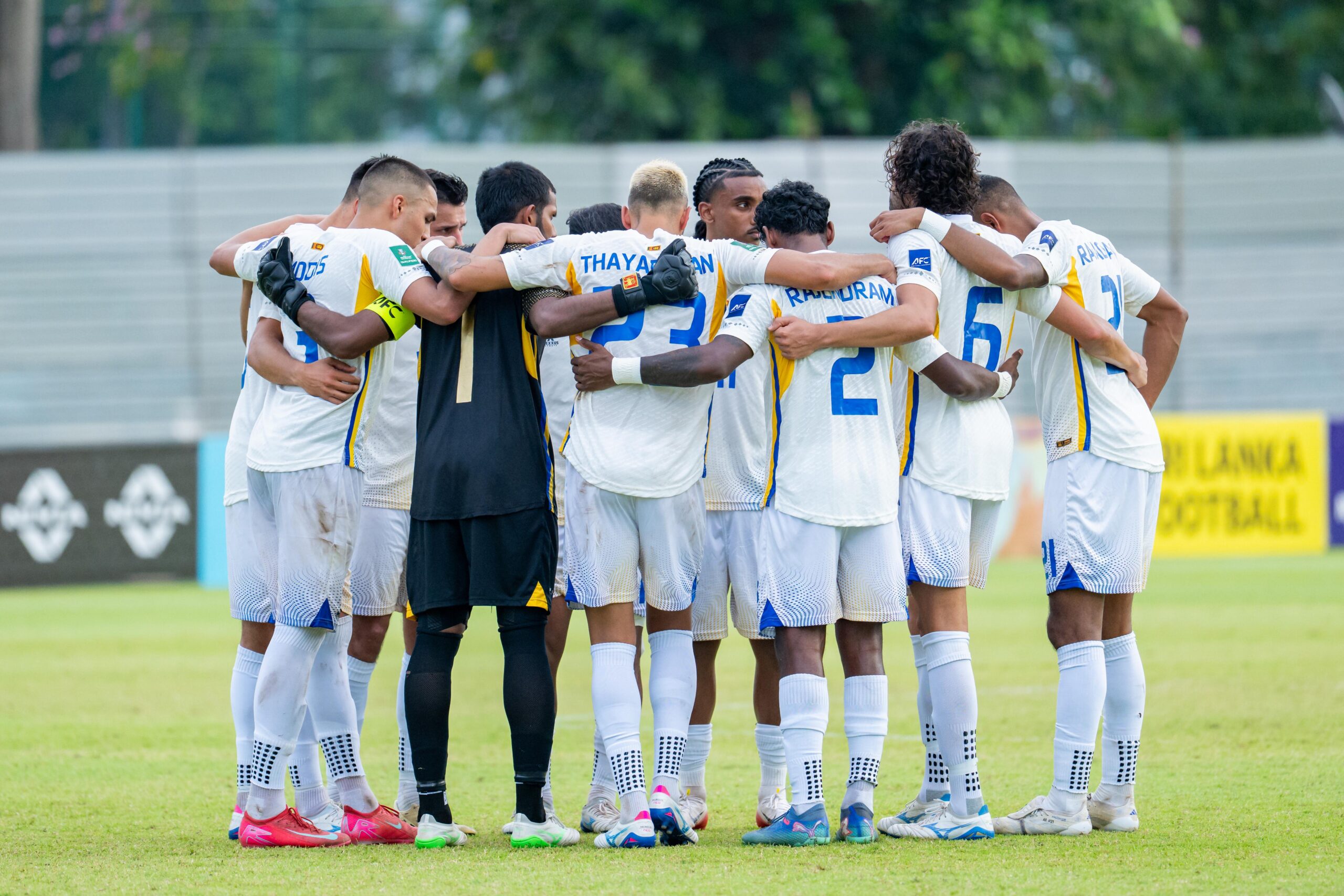
Sri Lanka will begin their 2026 SAFF Championship campaign against Bhutan on November 8 in Dhaka, with the opening Group A encounter carrying major importance in what is set to be a short and unforgiving battle for a place in the semi finals.
The Lions will meet Bhutan at the National Stadium in Dhaka before facing hosts Bangladesh three days later on November 11. With only three teams currently making up Group A and the top two progressing to the knockout stage, every result carries significant weight.
That format makes Sri Lanka’s first appearance particularly important. A victory over Bhutan would immediately place them in a strong position ahead of their final group fixture against Bangladesh, while dropped points could leave the team facing a must-win situation against the hosts.
Sri Lanka enter the tournament with encouraging recent form and considerably greater confidence than in previous campaigns.
One of the biggest reasons for that optimism is their recent record against Bhutan.
The two nations met in an international friendly in Bangkok on June 8, with Sri Lanka producing an impressive 4-1 victory. Wade Dekker opened the scoring in the 16th minute before Barath Suresh doubled the advantage after the interval. Waseem Razeek made it 3-0, and although Rinzin Dorji pulled one back for Bhutan, Rahul Suresh completed the scoring in stoppage time.
That result should give Sri Lanka confidence, but tournament football presents a very different challenge.
Bhutan will have had several months to analyse what went wrong in that defeat, while their own opening match against Bangladesh on November 5 will give them competitive experience in Dhaka before facing Sri Lanka. Sri Lanka, in contrast, will have to enter their first group game ready to perform immediately.
There is little margin for a slow start.
Sri Lanka’s recent international programme appears designed specifically to avoid that problem.
The national team travelled to Seychelles in September and produced two strong performances, winning the opening encounter 3-0 before completing the two match assignment with another clean sheet victory.
Adhavan Rajamohan scored twice in the first game, including a penalty and a free kick, while Dillon de Silva added the third.
Sri Lanka then continued to test themselves away from home with matches against Mauritius.
After suffering a 3-0 defeat in the first meeting, which was treated as a practice fixture, they responded impressively in the official international on October 5.
Mauritius took an early lead, but Sri Lanka recovered to claim a 3-2 victory, with Rahul Suresh, Niloshan Senthurvasan and Sam Durrant among those finding the net according to match reports.
The victory was particularly encouraging because Mauritius entered the contest ranked above Sri Lanka.
More importantly, it showed that the side could respond after falling behind and still secure a result away from home, an attribute that could become crucial during the pressure of the SAFF Championship.
The upcoming tournament represents another major step in Sri Lanka’s attempt to restore its position within South Asian football.
Sri Lanka’s only SAFF Championship title came in 1995, and the national team has spent three decades trying to recreate that success.
The current preparation programme has been built around a clear ambition to challenge again, with the recent friendlies against Bhutan, Seychelles and Mauritius providing valuable international minutes before the regional competition.
Sri Lanka’s attacking options have offered several encouraging signs.
Rajamohan showed his ability from both open play and set pieces against Seychelles, while Dillon de Silva has also been involved in important goals during the team’s recent run.
Experienced forward Waseem Razeek remains another threat and was on target when Sri Lanka defeated Bhutan in June.
The emergence of players such as Rahul Suresh and Barath Suresh has also added depth to a squad that appears increasingly capable of producing goals from different areas of the pitch.
Defensively, Sri Lanka’s back to back clean sheets against Seychelles were another positive.
Tournament football often rewards teams that can remain organized when matches become tight, and the Lions may need that discipline against both Bhutan and Bangladesh.
Their recent 4-1 win over Bhutan could make Sri Lanka favourites for the November 8 contest, but history provides a warning against underestimating their opponents.
Bhutan defeated Sri Lanka in both legs of their 2015 World Cup qualifying encounter, winning 1-0 in Colombo before claiming a 2-1 victory in Thimphu.
Sri Lanka have since turned that rivalry around, winning 2-0 when the countries met in the FIFA Series in Colombo in 2024 before recording the 4-1 success earlier this year.
The latest meeting will therefore provide another indication of how far Sri Lanka have progressed.
The structure of this year’s SAFF Championship makes the situation particularly interesting.
Group A contains hosts Bangladesh, Bhutan and Sri Lanka, while Group B features defending champions India, Maldives and Pakistan. The top two teams from each section are scheduled to advance to the semi-finals on November 14, with the final taking place on November 17.
For Sri Lanka, that means there are effectively only two opportunities to secure a semi final place.
A convincing performance against Bhutan would not only provide three valuable points but could also improve goal difference, something that may become decisive if teams finish level.
It would also remove some of the pressure before the final meeting with Bangladesh, who will have the significant advantage of playing in front of their home supporters.
Sri Lanka cannot afford to look that far ahead, however.
The immediate task is Bhutan.
Recent results suggest the Lions have the attacking quality to hurt them, while the team’s international preparation has provided confidence and competitive experience.
What Sri Lanka must now demonstrate is the ability to reproduce those performances when the stakes are considerably higher.
Friendly victories can build momentum, but SAFF Championship football will ultimately determine whether that progress translates into something meaningful.
Sri Lanka arrive in Dhaka with stronger form, recent success against Bhutan and renewed belief behind them. But with only two group matches available to reach the semi finals, the November 8 opener is much more than the beginning of their campaign. It could be the result that shapes their entire tournament.