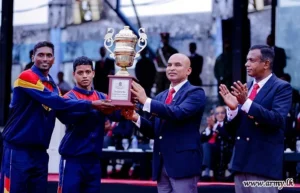
Sri Lankan tennis has reached an important new stage in its development, with the launch of the Sri Lanka Tennis Premier League, improved infrastructure, stronger commercial partnerships and growing opportunities for young players combining to create fresh momentum for the sport.
The launch of the Sri Lanka Tennis Premier League, or SLTPL, has been one of the biggest developments of 2026.
Endorsed by the Sri Lanka Tennis Association, the inaugural competition introduced a franchise-based format designed to bring together leading local players while also creating a more sustainable commercial structure around the sport.
The first edition featured eight city based franchises representing Colombo, Jaffna, Batticaloa, Kurunegala, Kandy, Nuwara Eliya, Galle and Negombo.
Rather than operating simply as another domestic tournament, the league has been designed as a long term development platform.
Organisers have described the project as an effort to improve player pathways, attract greater private-sector investment and provide tennis with a stronger professional identity in Sri Lanka.
The competition also introduced a more modern approach to tournament management, including digital player registration, franchise auctions, live scoring, rankings, results management, statistics and performance analysis.
That digital structure is particularly significant.
For many years, Sri Lankan tennis has relied heavily on traditional tournament formats and a relatively small competitive community.
The SLTPL model attempts to present the sport in a way that can appeal to a broader audience while giving sponsors and commercial partners clearer opportunities to become involved.
Corporate support arrived quickly.
CL Synergy joined as title sponsor, Wilson became a key partner, Cinnamon Life was announced as hospitality partner and DIMO joined as the exclusive luxury automobile partner during the league’s launch phase.
The competition also produced its first champion, with Kandy Kings winning the inaugural SLTPL title in August.
That success later helped the franchise secure a three year title sponsorship agreement with Odiliya Residencies, covering its participation across tennis, golf, pickleball and rowing.
The development of the league has been accompanied by significant improvements to tennis infrastructure.
DIMO partnered with the SLTA and SLTPL to install international-standard floodlighting across four major hard courts at the SLTA complex, including the centre court.
The upgraded lighting system was designed to allow evening training and competition while creating conditions closer to those found at major international venues.
This could have an important impact on player preparation.
Evening access provides more training opportunities for school athletes, university players and professionals who may otherwise have limited access to courts during the day.
It also opens the possibility of hosting more night matches and events, which could improve the spectator experience and increase broadcast potential.
Infrastructure is only one part of the wider plan.
The SLTPL has also been linked to the creation of a Tennis Development Fund, with surplus revenue from the league intended to support grassroots programmes, coaching pathways, facilities and player development around the country.
That model could prove particularly important for young players outside Colombo.
Historically, many of the strongest opportunities in Sri Lankan tennis have been concentrated around major clubs and the SLTA complex in the capital.
Expanding coaching and competition into additional districts could help the sport identify players who may otherwise never reach the national system.
Junior performances are already providing reasons for optimism.
Sri Lankan players have continued to compete in international junior events, while local ITF tournaments have given emerging athletes valuable exposure without requiring them to travel overseas for every competition.
In September, four Sri Lankan boys advanced to the third round of an ITF junior event staged at the SLTA courts in Colombo, demonstrating the depth of talent developing within the local system.
Ganuka Fernando has also produced notable results internationally.
In late 2025, he reached the boys’ singles final of the ITF World Tennis Tour Juniors J30 event in Pokhara, Nepal, becoming the first Sri Lankan boy in many years to reach an overseas ITF final.
The domestic game has shown encouraging signs as well.
The 111th Sri Lanka National Tennis Championship produced one of the standout individual achievements of the year when Thehan Wijemanne claimed a triple crown by winning the Men’s Singles, Men’s Doubles and Mixed Doubles titles.
His singles victory also gave him his first national crown.
The longevity of the national championship itself is another reminder of Sri Lanka’s long tennis tradition.
Reaching its 111th edition places the tournament among the country’s longest running sporting competitions and gives the sport a strong historical foundation on which to build its modern ambitions.
The commercial and competitive changes introduced in 2026 therefore represent more than a temporary expansion.
They signal an attempt to connect Sri Lanka’s existing tennis tradition with a more modern professional structure.
That combination could be important.
A league can attract sponsors and audiences, but long-term success still depends on producing better players.
Improved facilities can support training, but young athletes also need quality coaching, competitive matches and clear pathways towards international tournaments.
The next phase will therefore determine whether the progress made in 2026 can be sustained.
The SLTPL must continue attracting strong players and commercial partners.
The Tennis Development Fund must deliver measurable benefits.
Infrastructure improvements need to reach beyond Colombo.
And Sri Lankan juniors must receive enough international exposure to bridge the gap between domestic success and higher level competition.
There are nevertheless encouraging signs that tennis is gaining greater visibility.
Events such as the SLTPL create new narratives around teams and players, while improvements at the SLTA venue enhance the overall presentation of the sport.
International brands have also shown greater involvement.
Wilson officially launched its Blade V10 range in Sri Lanka in July, with the event bringing together Davis Cup players, Billie Jean King Cup representatives, coaches and juniors at the SLTA.
That kind of engagement can help create a stronger tennis culture.
Young players benefit when elite competition, modern equipment, better facilities and successful local role models become more visible.
For supporters, meanwhile, a franchise league gives them another reason to follow domestic tennis beyond traditional individual championships.
Sri Lanka still faces a significant challenge if it wants to produce players capable of consistently competing at the highest professional level.
But building that future begins with creating the right environment.
The developments of 2026 suggest that the foundations are gradually being strengthened.
With a new franchise league, international standard court upgrades, stronger commercial backing and a growing group of emerging players, Sri Lankan tennis appears to be entering one of its most ambitious periods in recent memory. The milestone is not simply one tournament or one result, but the creation of a broader platform that could shape the sport for years to come.