Max Verstappen says Formula 1 has become a less stressful environment since Christian Horner’s departure from Red Bull, while the four time world champion has also opened up about Ferrari, his long term commitment to his current team and how much longer he expects to remain in the sport.
Verstappen’s comments come at an important moment for Red Bull. The Dutchman has just claimed his first Grand Prix victory of the 2026 season in Malaysia and recently ended months of speculation over his future by signing a contract extension that keeps him with the team through the end of 2030.
His relationship with Red Bull has been one of the defining stories of modern Formula 1.
Verstappen joined the senior team in 2016 and went on to win four consecutive Drivers’ Championships between 2021 and 2024, with Horner overseeing every one of those successes.
However, the atmosphere surrounding Red Bull became increasingly complicated before Horner left the team in 2025.
The former team principal was frequently involved in tense exchanges with rival bosses, particularly Mercedes chief Toto Wolff and McLaren’s Zak Brown, while internal uncertainty at Red Bull also became a regular subject of discussion around the paddock.
Verstappen has now admitted he prefers the calmer atmosphere that has followed.
Speaking ahead of the Singapore Grand Prix, he explained that constant tension between people can make an already demanding Formula 1 environment even more stressful.
The Dutchman acknowledged that the sport may appear less dramatic from the outside without some of the previous confrontations, but said he personally prefers seeing teams and senior figures maintain friendlier relationships.
For Verstappen, reducing unnecessary tension is particularly valuable because Formula 1 already places enormous demands on drivers, engineers and team personnel throughout a long season.
His comments are notable because of the success he enjoyed during Horner’s leadership.
There was no attempt to dismiss what the former Red Bull boss achieved.
Verstappen acknowledged that Horner had demonstrated his ability as a team principal and played an important role in building Red Bull into one of Formula 1’s dominant forces.
But when asked about Horner’s attempts to return to the sport, Verstappen made clear that the issue is no longer something he is concentrating on.
Horner has repeatedly been linked with a Formula 1 comeback and has publicly described Ferrari as a potential dream destination.
The speculation intensified recently when Ferrari team principal Frederic Vasseur came under renewed scrutiny, although Ferrari subsequently made clear that Vasseur retains the support of the organisation and both Lewis Hamilton and Charles Leclerc publicly backed him.
Verstappen said Horner would likely return if the right opportunity became available, but indicated that he had no involvement in deciding where his former boss might go next.
Interestingly, Ferrari was also part of the discussion surrounding Verstappen’s own future.
Few drivers in Formula 1 history have been immune to speculation about eventually wearing Ferrari red, and Verstappen is no exception.
The Dutchman made clear that he has enormous respect for the Italian manufacturer and understands its unique status within Formula 1.
But sentiment alone would not convince him to move to Maranello.
Verstappen described himself as completely performance driven, stressing that there would be little attraction in joining Ferrari purely because of the badge if the car was only capable of fighting around fifth or sixth position.
His approach could be summarised by one simple statement: “I only want to win.”
That philosophy helps explain why Verstappen ultimately chose to renew his commitment to Red Bull.
Earlier in the season, his future appeared genuinely uncertain.
Red Bull had struggled under Formula 1’s new technical regulations, while Verstappen’s representatives were understood to have held discussions with McLaren during the summer. Mercedes had also shown interest in him during previous seasons.
Verstappen’s previous Red Bull contract was due to run through 2028, but performance related exit clauses created the possibility that he could leave earlier.
Those questions disappeared in August when Red Bull announced an extension keeping him at the team until the end of 2030.
The decision means Verstappen has committed himself to another major phase of Red Bull’s development.
Rather than joining an already established championship contender elsewhere, he appears motivated by the challenge of helping rebuild the team into Formula 1’s dominant force.
He described Red Bull as a second family and said the opportunity to help turn the organisation around is one of the factors driving him forward.
The timing of those comments is particularly interesting after Red Bull’s breakthrough performance at the Bahrain Grand Prix in Malaysia.
Verstappen had gone through the first 15 races of the season without a victory, an unusually long drought for a driver who had become accustomed to dominating races during Red Bull’s previous championship era.
At Sepang, however, Red Bull finally delivered.
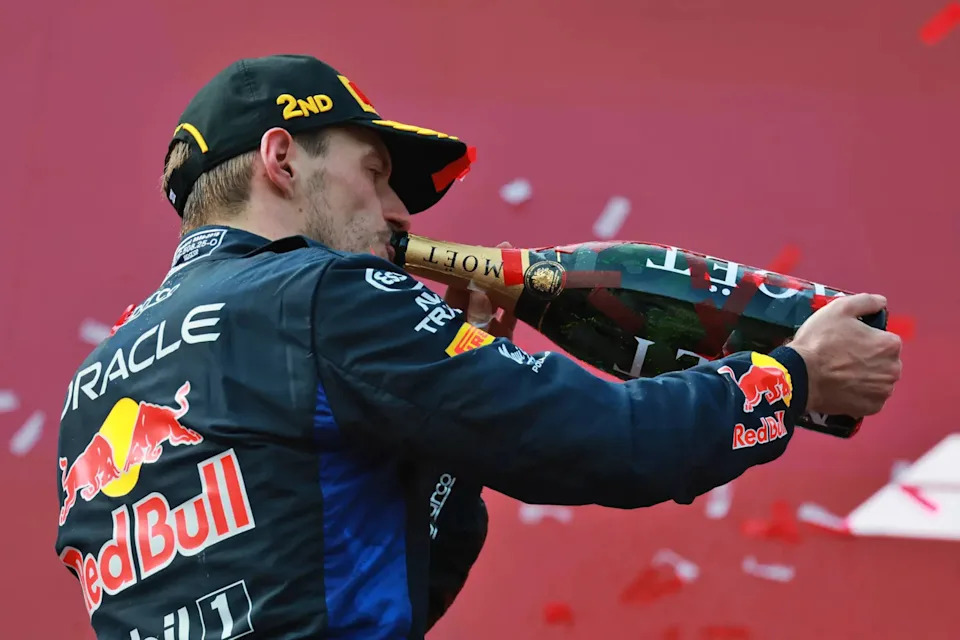
Verstappen claimed his first pole position of 2026 before winning a chaotic, rain-affected race ahead of championship leader Kimi Antonelli and Ferrari’s Hamilton.
It was Verstappen’s 72nd Formula 1 victory and Red Bull’s first Grand Prix success of the season.
That result offered evidence that his decision to remain with the team may already be beginning to pay off.
Red Bull have introduced several improvements in recent races, and Verstappen believes the remaining rounds of 2026 can provide valuable information for developing next season’s car.
The reigning championship battle is largely beyond his reach, but individual victories and stronger performances could provide momentum heading into 2027.
Singapore will offer another important test.
The Marina Bay Street Circuit is dramatically different from Sepang, with slow corners, narrow barriers and intense heat creating a completely different challenge.
Verstappen has also never won the Singapore Grand Prix, meaning another victory would represent a significant achievement even without championship implications.
His new contract does not necessarily mean Verstappen intends to remain in Formula 1 indefinitely.
Fernando Alonso recently extended his Aston Martin deal into his late 40s, but Verstappen does not expect to follow a similar path.
The Dutchman, who is 29, said racing into his mid 40s would mean dedicating more than half his life to Formula 1, something he currently considers unlikely.
Instead, Verstappen plans to reassess his motivation later in his new contract.
If he still feels capable of giving Formula 1 his complete commitment, he could continue. If other interests become more important, he has indicated he would be prepared to walk away.
Spending more time with his family is increasingly part of that calculation.
Verstappen has also frequently spoken about his interest in other forms of motorsport, including endurance racing, making it possible that his career after Formula 1 could remain heavily connected to competition without requiring the same demanding Grand Prix schedule.
For now, though, his focus remains firmly with Red Bull.
The Horner era has ended, speculation linking Verstappen with rival teams has eased and his future through 2030 is secure.
Most importantly, Red Bull have finally returned to winning form.
Verstappen may respect Ferrari and acknowledge everything Christian Horner achieved at Red Bull, but his priorities are clear – he wants a calmer environment, a competitive car and the chance to help rebuild the team that delivered all four of his world championships.