Sri Lankan football is set for one of the biggest development pushes in its history after FIFA outlined plans to provide approximately US$25 million in support over the next four year cycle, with funding expected to target infrastructure, youth development, women’s football, the national team, coaching and refereeing.
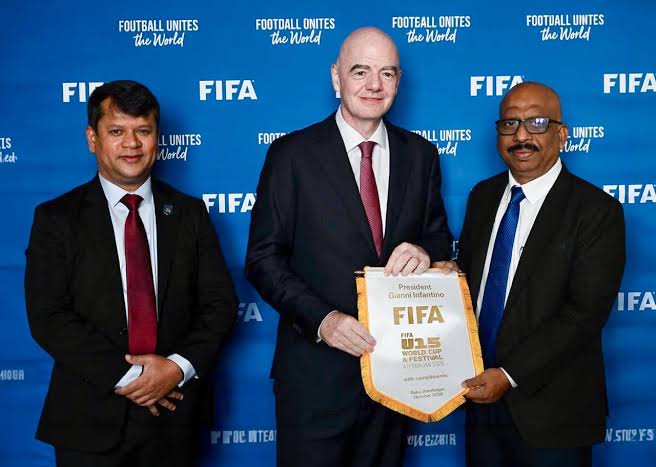
The proposed package was discussed during a high level meeting in Baku, Azerbaijan, between FIFA President Gianni Infantino, Sri Lanka’s Minister of Youth Affairs and Sports Sunil Kumara Gamage and Football Federation of Sri Lanka President Jaswar Umar. National Sports Council Chairman Priyantha Ekanayake and High Performance Centre lead Prasanna Jayalath were also part of the Sri Lankan delegation.
The meeting centred on a long term development roadmap designed to expand football throughout the country and raise the overall standard of the game.
A major objective of the plan is to make football one of Sri Lanka’s most popular sports within the next four years while creating clearer pathways for talented players to move from grassroots competition into elite football.
The US$25 million is expected to be spread across the coming four-year development cycle rather than being released as a single payment.
According to reports, the Football Federation of Sri Lanka will need to submit detailed proposals outlining how the funding will be used across areas including grassroots programmes, infrastructure, women’s football, junior development, national teams, coaching and officiating.
That structure places considerable responsibility on the FFSL to ensure the investment is translated into sustainable programmes rather than short term projects.
One of the most significant areas discussed was football infrastructure.
Plans include the development of an international standard stadium and the expansion of football grounds across the island.
Work towards establishing football facilities in every district is expected to begin next year, while the FFSL has also outlined an ambition to develop around 40 grounds through its member leagues by the end of 2031.
For Sri Lankan football, improved facilities could become one of the most important parts of the programme.
Many young players outside the main urban centres have limited access to quality pitches, organised coaching and regular competition.
Developing grounds in more districts could make the game more accessible while creating stronger regional pathways for identifying talented players.
The proposed funding is also expected to support the national team.
Sri Lanka has shown encouraging progress during the past two years and has climbed significantly in the FIFA world rankings.
Recent reports noted that the country had moved 23 places from a previous ranking of 207 to 184, progress that was highlighted during discussions with FIFA.
That improvement has been accompanied by several positive results at international level and growing optimism around the direction of the national setup.
However, maintaining that progress will require stronger domestic structures, more competitive matches and better long term preparation.
The FIFA support could help provide those foundations.
Youth development is expected to be another major priority.
Infantino highlighted the importance of youth tournaments and football festivals as tools for discovering talent and giving children greater opportunities to develop their skills.
A stronger youth structure would also allow Sri Lanka to build national teams from a broader player base rather than relying heavily on talent identified relatively late in the development process.
Women’s football is also included in the proposed package.
This is particularly important because sustainable football development requires investment across the entire game rather than focusing only on the men’s national team.
More organised competitions, better coaching and improved facilities could help Sri Lanka increase participation among girls and create stronger pathways into national youth and senior women’s squads.
Coach education and referee development will form another key part of the programme.
Improving the quality of players alone will not be enough if coaching standards and match officiating do not progress at the same pace.
FIFA’s technical expertise could therefore become as valuable as the financial assistance itself.
A larger number of qualified coaches working at grassroots and youth level would improve the quality of training young players receive, while better referee development could help raise standards across domestic competitions.
The discussions in Baku also covered the creation of a National High Performance Centre.
FIFA is expected to provide technical knowledge and infrastructure support in partnership with the Sports Ministry and FFSL.
The proposed centre would focus on player development, higher coaching standards and more professional training pathways for talented footballers.
A dedicated performance environment could be particularly valuable for Sri Lanka’s national and elite youth teams.
Modern football increasingly depends on sports science, data analysis, strength and conditioning, nutrition, recovery and tactical preparation.
Bringing those services together could allow national players to prepare in a more professional environment throughout the year.
The scale of the proposed FIFA support is also notable compared with previous funding levels.
The Sunday Times reported that funding available to Sri Lankan football was being increased from around US$10 million to US$25 million from next year, while FIFA has also committed 25,000 footballs for domestic, youth and women’s development programmes.
That represents a substantial opportunity for the federation.
It also means transparency, planning and accountability will be crucial.
Large infrastructure projects can improve football only when they are connected to regular competitions, effective coaching and player development programmes.
A new stadium or training ground will have limited long term impact if there is no clear pathway for players to use those facilities and progress through the system.
The FFSL therefore faces the challenge of connecting each part of the programme.
Grassroots participation must lead into youth competitions.
Youth players need opportunities to enter regional and national development squads.
Coaches need access to education and modern methods.
Referees require structured training.
Domestic clubs need stronger competitions.
And the national team must ultimately benefit from a deeper and better prepared player pool.
The Government has indicated that it intends to work closely with FIFA and the FFSL in delivering the programme.
Sports Minister Sunil Kumara Gamage thanked FIFA for its support and reaffirmed the Government’s commitment to accelerating football development throughout the country.
For FIFA, the programme also reflects its wider development strategy of supporting member associations through infrastructure, technical programmes and grassroots investment.
Sri Lanka now has an opportunity to use that support to create a more sustainable football structure rather than simply targeting immediate results.
There is already considerable interest in the national game ahead of major regional competitions.
A stronger SAFF Championship campaign, improved Asian Cup qualifying performances and continued progress in the FIFA rankings could help generate further public attention.
But the proposed US$25 million investment is ultimately designed to create something much broader than one successful tournament.
Its success will be measured over several years.
More young players entering organised football, stronger women’s competitions, better trained coaches, improved grounds and a national team capable of competing consistently at a higher Asian level would all represent signs that the programme is working.
For Sri Lankan football, the proposed FIFA package could become a rare opportunity to transform both the top and bottom of the game at the same time. If the US$25 million is backed by careful planning, transparent implementation and sustained development, it could provide the infrastructure and player pathways needed to build a far stronger football culture across the country.